Showing posts with label vocabulary. Show all posts

Monday, 18 May 2015

Maman, en français, c'est La Reine des Neiges

Maman, en français c'est la reine des neiges” [Mama, in French its the snow queen i.e. the name of the Frozen movie in French] proclaimed Poppette yesterday afternoon as she sat around a table with her young English friends singing 'Do you want to build a snowman' and generally getting giddy about the Disney Frozen movie.

Just a few words but so very telling.

Being totally honest and laying my cards on the table, I am at a stage where I am extremely grateful for these small reminders that my children can and do speak French this being despite me and my best efforts to sabbotage the whole thing. Seriously. Over the past two years I have been far from consistent. I take full responsibility as little by little more and more English conversations have sneaked into our life. Partly because of being so busy, partly due to tiredness and laziness and perhaps also a lack of conviction. I remember a chat I had a few months ago with Belgian Maman (those of you who have been following our adventure for a while will recall that Belgian Maman is native French speaker who speaks only English with her two little ones) during which she pointed out the problem I was having was that having allowed a little English to creep in now and again, over time this had snowballed and it had become to feel the norm. I should really be more aware of this as I do tend to have an all or nothing personality. Routine and consistency are key for me.

It seems to be fairly widely acknowledged within the bilingual community that bilingual life can be tiring and takes real commitment even when using ones native language. Going the non-native route is likely to be a little trickier now and again because it’s not just the commitment and consistency that you have to battle with, it’s the lack of words at certain times. I think that, because of this, I have perhaps slipped into letting myself off the hook a little. I’ve used it as an excuse to “cut myself some slack” when, in reality all I have been doing is allowing myself to wander further and further away from my goal.

Crazy.

I implore you not to do the same.

It is not too late for us to recover from this. I know this simply because my children have proved that even though I dropped the ball, they picked it up and ran with it for me.

There are millions of little moments that remind me that they can and do speak French and that they are proud to do so. Such as when they comment on a French story I have just read to them, or when they drop obscure French words into conversation that I may have only used with them once or twice previously, or when we are in the car and they play who knows the most French words, or when one of them proclaims, "Mama, I know how to speak French but X doesn't" or when they are watching French TV and repeat whatever they have just heard even though I would have sworn blind that they weren’t listening. There are so many of these little moments that wouldn’t arise had we not had this dream of a bilingual household.

There are other occasions, however, when there is some resistance. Poppette, for example now refuses to join in with her weekly French class at pre-school. This doesn’t worry me as I think that it’s a boredom issue (chatting about colours and animals and foods etc. each week) although I had hoped she would enjoy the group interaction and signing. She has also started to pretend not to understand something when she clearly does. I’m not sure what makes her do this. She asks questions like “What is cinq [five]?”. I don’t give in to it as I know she knows but it’s a reminder to me that I can’t get away with the lack of consistency in my approach to their language acquisition forever.

Already I know that had I been as consistent over the past two years as I had been over the first two years, then our current language environment would be different. That’s part of the reason for me stepping up to the keyboard today. To share the reality of where our non-native adventure is at the moment and also to set my stall out about where that adventure will lead us next.

In this vein, I came across a great book recently called “The One Thing” by Gary Keller and Jay Papasan. The premise of the book is that you should choose the one thing in life (or in each area of life) that is of most importance to you and that every decision or choice you make is based on whether or not it brings you closer to that goal. All of a sudden you can begin to see how a myriad of small choices you are making daily serve no real purpose and in no way lead you where you want to be heading. It’s all about being more intentional.

In fact, there’s a great short story that Poppette loves right now that really grabbed my attention recently. It begins “Je suis une petite graine plantee dans la terre….” [I’m a little seed planted in the ground...”]. As I acted the story out with her, doing the actions to represent this tiny seed, uncoiling, growing and stretching towards the sun, I realised that this language that I am sharing with my children is like that little seed. If I water and nurture it, it will most likely become la plus belle fleur du monde [the most beautiful flower in the world] and if I neglect it, deprioritise it and use our majority language instead… that poor little grain is likely to wither and die.

What a shame that would be after four and a half years of effort from our little family.

Thursday, 15 May 2014

Poppette corrects Little Man's French

Poppette corrected Little Man's French last night.

I didn't know what to do first...(a) star jumps or (b) run for a pen and a scrap of paper before I forgot the details of their little exchange.

Guess what I went with lol

The conversation (which may lose a little in translation as the pronunciation is quite key here) went like this:

Little Man: "My chaussonzzz" (chaussons i.e.my slippers) - in French the 'S' here is silent but Little Man went all English on us and pronounced the 'S' :-)

Poppette: "No, they're 'chaussons'"

(She did this with a silent 'S' and in a pefect little French accent)

Swoon.

One happy mama.

Sunday, 11 May 2014

Maman, Le Monsieur Tond Le Gazon

Something Poppette (aged 3 ½) said to me recently spurred me on immensely. We were lounging around in the garden on a sunny Sunday afternoon when we heard the sudden roar of the neighbour’s lawnmower.

Maman” exclaimed Poppette “Le monsuier tond le gazon” (Mummy, the man is mowing the lawn). Seriously, this just ticks all the boxes. Not only had my daughter just spoken an entire, grammatically correct sentence to me in French but it was something so random and unexpected that it made me understand that she is just absorbing everything like a sponge.

Poppette’s language use at the moment can be summed up as being a real mix. She speaks English with English people, a mix of English and French with me and mainly English with Papa and Little Man with random bits of French thrown in. She very rarely uses full French sentences (although it appears that she can when she wants to). She comes out with things that surprise and impress me in equal measure.

I think the issue here is that I look at language acquisition from the perspective of a monolingual English speaker who learnt other languages through school etc and because of this, I have a subconscious sense that the words or grammatical structures I (and scores of my classmates) grappled with will also be tricky for her. This is not true. In reality, every French word is as easy or difficult as the next in the mind of a bilingual child or infant language learner. A word is just a word. A good example would be the fact that many English speakers struggle at first to differentiate between les chevaux (horses) and les cheveux (hair). Poppette proved to me that this is very much not the case for her recently as we drove past a field of horses and she exclaimed “Oh, des chevaux!” (oh, horses). She will never confuse the two. So the lesson here for me is that I need to stop projecting my weaknesses or concerns onto her and just continue to speak.

Little Man is also progressing in leaps and bounds. He has been a very chatty Little Man for a long time. By the age of 18 months he could put three (English) words together and has always had a really good understanding of the concepts of me and I etc which I think sometimes children don’t quite grasp at first. Now, at 25 months old, he chatters away quite merrily in both English and French although, in French he uses single words rather than sentences.

There are, in fact, some words that my children never say in English, at least, I’ve never heard them use the English word. Such as salon (living room), salle de jouets (play room), calîn (cuddle), essuie-tout (kitchen roll), linge (laundry), douche (shower) and serviette (towel). Also, there are a few terms that cause immense confusion when we have visitors... particularly the fact that Noddy is known as Oui-Oui (pronounced wee-wee in French) and he is Little Man’s favourite cartoon character... when Little Man wants the potty he tells us he wants to do a pipi.

So, I definitely feel things are moving along steadily in the right direction, DESPITE me having had the several wobbles over the past 12 months or so and DESPITE the fact that rather than speaking 100% French I speak more like 80% French with them right now and..... horror of horrors ..sometimes read books to them and sing to them in English too.

Monday, 2 September 2013

Back on the blogging horse

Wow, has it really been nearly five months since I wrote anything here on my beloved blog. Seriously, I can't believe it. Life has been a total whirlwind with my feet very rarely touching the floor for long enough for me to keep on top of everyday life, let alone indulge in the luxury of writing a blog post.

The last few times I wrote, I was most definitely feeling unsure as to whether I wanted to carry on speaking French with Poppette and Little Man. Knowing we were due a family holiday to France this August, however, I told myself that I would be a fool to stop before then as I ought at the very least give my children the opportunity to explore what they know (and, of course, show me and hopefully nip all my fears in the bud) whilst totally immersed.

I was right to wait.

Whoever spoke to Poppette, in what ever environment, be it in the local supermarket or pharmacy, the ticket lady on the merry-go-round, our French friends, our next door neighbours, she understood and spoke back to them. It was a crazy feeling to realise that my daughter (who will be 3 years old in less then two month's time) really speaks French and that, had I not pushed myself through the doubting and spoken to to her in French all this time, we would have arrived on holiday and she would have understood 'rien'! Likewise, for Little Man (now 17 months old) who, although he still only has a few French words in his spoken vocabulary, clearly understands French when it is spoken to him.

The holiday was amazing on many levels - I mean, put me in France and watch me float - just being there makes me happy. But to watch my children just fall into being a part of it all. Wow! Watching them play in French with our friends' two little boys (who are French and also French/ English bilinguals) was just brilliant... The game un, deux, trois soleil for one really seems to have stuck with both Poppette and Little Man who still cover their eyes every time they hear the words. Also, our friends spoke only French with my little ones which was priceless.

One day whilst in France, Poppette came to me and said "Maman, je veux manger" [Mummy, I would like something to eat] - until that point, she had always said "Maman, I want manger" so, in my eyes this was a huuuuge step..... the minority language immersion environment helped push the majority language out.

She's gone right back to saying "Maman, I want manger", now were home, but at least I know now that there are words in her head just waiting for the right opportunity to come back out and that this will be just the same with Little Man.

It's back to that old chestnut of just having faith. Believe it will work and it will. Keep working towards your goal. It's not always easy (far from it, at times, to be honest!!) but.... well, the proof is in the pudding.


Friday, 3 May 2013

Language Mixing & Code Switching

Poppette is now 30.5 months old and, the more her language skills develop and the more able she is to speak in full sentences, I notice her substituting words from one language for another.

I can't honestly say what influences her choice as, often times, she knows the appropriate word in both of her languages.

The interesting thing for me is how she always manages to construct grammatically correct sentences even when mixing the two languages together.

I want to capture these so I can look back and smile, so I'm going to add them to my "Poppette & Little Man" page.

A couple of cute examples are:-

Pas go au lit [Je ne veux pas aller au lit]

Don't want it, go au lit. [Je ne veux pas aller au lit]

Ça va très fast [Ça va très vite]

Ça move [Ça bouge]

She also has some cute language quirks where she uses the structure from one language when speaking the other such as calling orange juice 'juice orange' [jus d'orange] or like this morning when she proudly announced "I make big sleep" [j'ai fais gros dodo] i.e. I had a big sleep!

Thursday, 25 April 2013

Non-Native Treasure Trove: Everything there is to know about the summer

I've just ordered a new book and am super excited!

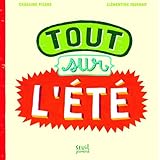
It's called Tout sur l'été and, if I'm totally honest, it's more of a purchase for me than it is for les enfants!

In a bid to keep up with Poppette's knowledge thirsty mind and French language needs, I'm trying everything I can to increase my own vocabulary so I don't get caught on the hop quite so often.

This book sounds like the perfect antidote to that all too common brain freeze.

Détails sur le produit

It looks at pretty much everything you can think of that relates to the summer season split into three sections :- animal life, nature and daily life.

It explains scientific stuff (using a little character called Loupiote who shares his knowledge comic strip style) e.g. Why is the weather warm in summer? What causes thunder storms? Why do stars shine in the night sky? Why is it important to protect bees?

It also covers topics such flowers, insects, fruits and vegetables, all from the angle of what happens to them in the summer months. What's it like up a mountain in the summer months? Or by the sea? Why do cows produce more milk in summer?

There are also poems, rhymes, recipes and activities for the children to get involved in to help with their discovery.

A serious gem of a find.

The icing on the cake is that this book forms a part of a series. Yep... guess who'll be coughing up for a copy of Tout sur l'automne and Tout sur le printemps when the seasons begin to change!

I'll let you know whether it lives up to the hype and to my expectations when it arrives!

Now all I have to do is find time to read it. Oh Lordy.

UPDATE : 2nd May 2013

My book arrived a couple of days ago and I'm not disappointed! It's everything I had hoped for.

Here's a few photos of what you can expect to find inside:


Friday, 19 April 2013

The Subjunctive and Other Delights

Poppette is now 30 months old and her grammar skills in both English and French are developing a pace. Each day she uses words and sentence structures that I have not heard her use before. Watching her learn to express her inner thoughts really is a marvel.

The subjunctive just keeps popping out of her mouth ...Yes! The subjunctive... so many French language students grapple with that throughout their studies..... and my two year old can use it correctly because learning a language from birth is clearly a fabulous way to learn.

Like many toddlers, Poppette is a real creature of habit and creates routines left right and centre. Her new rule is that, at bed time, she can’t go to sleep unless Maman or Papa lay beside her bed, on her flower mat, under a blanket and go to sleep too! I am determined to break this routine.... as it's starting to take longer and longer for her to actually go to sleep as distracted as she is by the novelty of having a roommate!

Last night, I laid down obediently and waited for her to drop off but she was shifting around and around for what seemed like forever.... So, I piped up "Tu fais quoi, ma princesse?" [what are you doing, my princess]. To which Poppette immediately retorted..."Chut Maman, il faut qu'on dorme. [Ne] parle pas!" [Shhh mummy, we've got to go to sleep. Don't talk!"]. A perfect little subjunctive! Of course I was so damned excited about the French grammar bit that I promptly forgot about the fact that it was 10pm, I was starving and essentially barricaded in my two year old's bedroom!

Little Man (12 months) is showing continued signs of understanding and has added a new word to his list "more". He hasn't said anything in French yet (apart from doudou, which he has now been saying for a couple of days). I live in hope that more French words will follow. I need more time with him. I feel like he hears so little French compared to the intensive English environment they provide him with at nursery.


Friday, 8 March 2013

Language and My Little Man

Little Man is now eleven months old and is constantly "talking".

In and amongst his lovely baby chatter he has a selection of words, some of which he has been using for a good month or so and others which have just started to appear ... all English so far ... So,. it's time to start taking a note so I don't forget!

So far he says the following:

Mama
Papa
Nana
Grandad
There
Bye Bye

I've also heard him say yes and no but he doesn't use either regularly as yet.

People have actually been telling me for over a month now that they have heard Little Man say certain words but I haven’t always been there to hear them. I've been quite surprised really as I had a secret fear that he would start to speak late because I haven't felt that I have had the opportunity to talk him enough. It's not as easy with your second child as you just don't get the same amount of one on one time as you did with your first. Another whip to lash myself with... except for the fact that it turns out my worries were unfounded...Phew.

He definitely understands French. e.g.

Va chercher ton ballon [Go get your ball]
Assieds-toi [Sit down]
Tu veux manger? [Would you like something to eat?]
Viens ici [Come here]
Non! [No!]

Now I'm just hoping that my other worry i.e. the fact that I don't have huge amounts of time to speak French with him apart from on a weekend (and him being in English speaking nursery five days a week), won't be detrimental and stop him from speaking French. Friends have pointed out that, as he has heard me speaking to Poppette in French since he was born and also hears the French cartoons that Poppette watches etc, that he has quite a robust French environment so will be picking up more than I think.

Fingers crossed.

Tuesday, 19 February 2013

Non-Native Thought for the Day #5

One remarkable and definitely enviable thing about learning languages consecutively from birth is that the words come with no baggage, no preconceived ideas about what does and doesn't sound right and no mental blocks around the pronunciation of certain sounds.

The languages simply are what they are.

What a wonderful way to be able to see the world. From a position of acceptance, free of questions, doubts and insecurities.

I often get a reminder of this wonderful phenomenon when I listen to Poppette speak. She often freely uses words that I remember finding either hard to learn or perhaps ones that in the past I had avoided using as they just sounded odd to someone who's brain is hard wired first and foremost to the sounds of the English language.

This morning was a great example. Poppette (28 months) bounded out of the front door and exclaimed " [ Il ] fait [ du ] brouillard [it's foggy]. Now you don't get many words less English sounding and, therefore, more technically difficult to grasp as a starting French language learner than brouillard!

When words and phrases like this jump out of her mouth it makes me very happy that we chose to teach her both her languages together. It reminds me that there are so many benefits to doing it this way.

Another very handy benefit is never having to learn the gender of nouns! Oh what a delight... imagine just knowing that, regardless of whether it's a boy or a girl, a baby is un bébé and that an apple is une pomme whilst a grape is un raisin. I am so happy that my children will never have to grapple with genders because they will just instinctively know....

The flip side of that is, of course, that I need to be darned careful about making mistakes just in case they become hardwired into their little brains....grrrr.....more revision then!

Thursday, 13 December 2012

Getting Crafty.....Mon Beau Sapin

Today Poppette (almost 26 months old) and I talked about shapes and colours whilst she decorated her very own Sapin de Noël [Christmas tree] (made with green paper and my trusty roll of contact paper).

She has known loads of shapes for months now in both of her langauges (including ones that I have often thought a little obscure such as zigzag, oval and heart) and her colours have really come on in the last week or two.

The highlight for me was when, totally unprompted, she picked up the large green star and announced "étoile sommet" [star top] and stretched up and stuck it on.

Tuesday, 4 December 2012

Non-Native Treasure Trove : Il était une histoire

Il était une histore is a fantastic free resource overflowing with French stories, songs and nursery rhymes for children between the ages of 3 and 10.

It already boasts a catalogue of around 100 stories and a new story is added to the site every Friday.

An element that particularly appeals to me is the 'Documentaires' section which teaches children about different countries, the weather, various customs and much more.

To top it off, not only are the stories available to read, you can also opt to listen to them in MP3 format. Some even have a 'karaoke' option which allows children to read along.

A large part of the site is open for access to anyone. There's also a bonus section containing colouring pages, puzzles and printables if you register to the site.

For more information about how the site works, click here to see la visite guidée.

For those of you looking for English language activities to do with your children, you will also find an 'Anglais' section containing English stories and rhymes etc click here if you're interested.

Sunday, 2 December 2012

Non-Native Treasure Trove - 50 Ways to Encourage Your Child in French

Thinking of ways to group together the constant stream of great new resources that I come across, I decided to create a Non-Native Treasure Trove.

Each time I add something new, I will attach a "Non-Native Treasure Trove" label to make it really easy to find here on my blog.

First into the treasure chest is this list of 50 ways to encourage your child in French.

Saturday, 1 December 2012

Non-Native Thought for the Day #4

As I heard Poppette (25.5 months) "reading" out loud to herself in French recently, it struck me that there are ways in which her use of her minority language can be optimised. As you can imagine, this brought quite a smile to my face :D

When I say "reading", I mean that Poppette was telling herself the story from memory as she looked at the pages in her book. Toddler's memories are like sponges and Poppette has memorised loads of her favourite stories.

Some of Poppette and Little Man's books are in both languages, others are in just one. Where Poppette has only heard a story in French, naturally, when she "reads" it to herself, she does so in French.... and when I think about it, it's obviously the same for experiences that she has only experienced in French too such as un tour de manège [a ride on the merry go round] which she excitedly chatters about all the time at the moment.

So....my new non-native resolution is to try and step up the new experiences and language learning opportunities that we have and help Poppette to learn about these things in French first. I'm really hoping that this will help to keep the language as alive as possible, give Poppette a very good reason to continue to speak French and, hopefully, help to prevent the English immersion experience at nursery from overpowering our bilingual endeavour.

Friday, 30 November 2012

The Things They Say.....Hairy Noses :D

Poppette (25.5 months) is now talking in sentences using verbs, nouns and adjectives although she is not yet adding in the "he's, she's it's, the's or a's etc"....

Everyday she has me in stitches.

Everyday she makes my jaw drop with the words she knows.

Yesterday, I caught her tucking her Doudou into bed and saying saying "Fais [de] beaux rêves" [sweet dreams].

I've decided to start keeping a track of some of the classics so I don't forget. The children are growing and changing so quickly that it would be easy to forget some of these gems when others occur and take their place.

Yesterday morning, the first thing Poppette said to me when she woke was "X (name removed to protect the innocent :D ) poils nez, oui c'est ça" [X hairs nose, yes that's right]. The things they say !!! Honestly!!!

The background to this little phrase is that we had a visitor a few weeks ago and Poppette noticed the hairs in his nostrils. Being the curious little girl that she is this really caught her attention. The thing about Poppette is that she has a memory like an elephant. The hairs may be gone but the memory is deeply rooted :D

Monday, 12 November 2012

Le soleil se cache derrière les nuages...The sun is hiding behind the clouds

Two weeks after her 2nd birthday, Poppette spoke her first gramatically correct four word sentence. She was happily drinking her milk first thing in the morning when Little Man started to grumble to let us know that he was also rather hungry....Poppette looked over to him and announced "Bébé boit milk too" i.e. Baby drinks milk too.

I was really pleased on two levels...obviously from a language perspective this is fab...she may have mixed up her languages but she did so perfectly!! and I was also chuffed to bits at the obvious care and concern Poppette has for her younger brother.

Poppette is now almost 25 months old and her language is coming on in leaps and bounds. Papa has actually said recently that Poppette now often says things in French that he cannot understand. This is not a problem for him as he feels it is a small price to pay in exchange for his children getting the gift of bilingualism. It does, however, indicate that Poppette is beggining to use more complex vocabulary.

Yesterday we were in the car when she exclaimed "soleil cache derrière nuages" i.e. le soleil se cache derrière les nuages [the sun is hiding behind the clouds]. To be honest, she couldn't have timed it better as I have been a little despondent about this whole bilingual endeavour over the past few weeks. It can be quite exhausting always trying to think around ways to chat about things that you may never have thought about before in your second language. It can feel like trying to cram for a test.....every day. Add to that the fact that research suggests that the more the majority language exposure increases at the expense of the minority language the more of an upward struggle you will have to maintain your child's bilingualism.....and, well, it can feel like you're onto a losing battle. Both Poppette and Little Man will be in nursery 5 days a week from January :(

Rather than wallow in the why it might not work blues.... I am writing this post as a reminder to myself of just how far we have come in the two short years since my daughter's birth.

Poppette can count to ten in both English and French and does so all the time. I'd love to peak inside her head to see what influences her decision to pick one language over the other when she is playing alone.

We are still working on colours in both languages.  She definitley knows rouge/red in both languages  - as for the other colours, some days she gets them right and other days she doesn't so sometimes I am unsure whether she may just have guessed really well :D. Her knowledge of colours is definitley stronger in English right now.

We have been having regular playdates with a really lovely little French girl (5 months Poppette's senior) over the past few months. They play so well together, running around holding hands and giggling. It's such a pleasure to watch their friendship blossom. I have been really happy to note that when this young girl's mum chats away in French with Poppette, she understands perfectly. A good friendship has blossomed between us mamans too. Unfortunately, a move back to France in on the cards for them next month so our get togethers will have to come to an end.

Poppette's favourite mot du jour since this weekend is d'accord [ok]. She just came out with it whilst we were chatting and has not stopped saying it since.... much better than her other favourite word "noooooooo"!!!

At the moment she vascilates between speaking loads of French with me (about 80/20) to speaking about 50/50. That said, she only seems to speak French to other people if she doesn't know a word in English or perhaps favours the French word. Her language with Papa in the main is English although, although she peppers her converstaions with him with French words and phrases...some of which Papa understands and others that he doesn't.

I am trying to lift my game as far as Little Man is concerned and try to speak to him exclusively in French now. It still feels a little alien at times but I know it felt just the same when Poppette was tiny too.

Tuesday, 9 October 2012

Non-Native Thought for the Day #3

According to Wikipedia .... a homophone is a word that is pronounced the same as another, but differs in meaning. Such words may be spelled the same such as un tour [a tour] and une tour [a tower] or differently, such as vert [green], verre [glass] and ver [earthworm].

Needless to say, these sets of words have been exercising my brain!

The fact that the French use the same word to  refer to a plant pot and a potty left Poppette scratching her head when I asked her if she wanted to sit on le pot. I have since made a point of differentiating the plant pot by calling it a pot de fleurs!

Likewise, I find it a little hard to get my head around the fact that, in French, the word balançoire means both swing and seesaw...oh yeah! When I asked a French friend if she didn't find this a little confusing, she simply said, why should she. She said it was totally normal and actually she thought it a little odd that we have separate words. Right...well, I do see her point. I pushed on....asking her how on earth she would know what her son wanted to do if he said he wanted to play on the balançoire. How could she be certain not to disappoint him by taking him on the wrong ride? Simple, she said, I would just ask him whether he wanted to go on the balançoire that goes up and down or the one that goes forwards and backwards!

Belgian Maman has been having similar issues with English homophones whilst speaking non-native English with her son. "Don't touch the glasses", she said to him. He looked at her rather puzzled wondering why he would be committing an act of naughtiness by touching his lunettes [reading glasses] when his Maman was, in fact, referring to les verres [drinking glasses].

The conclusion I have come to, however, is that homophones are of no consequence to a native language speaker. You just don't think about them because you know them and have always known them and just absorb them throughout your language learning years through context and repetition and you instinctively know that your children will do the same. The issue when speaking a non-native language is that you question yourself more....if two (or more) words sound the same, you assume that your child will be confused because these words aren't second nature to you.

So...I am just getting on with it. Just because the word for sea [la mer] and mother [la mère] sound the same, doesn't mean that Poppette will be confused....at her tender age it's a question of context and, at a later stage, once she is able to read, all will become even clearer.

Click here to see a useful list of French homophones.

Have you any examples of how homophones have affected you in either a native or non-native context?

Sunday, 30 September 2012

9 Great Ideas for Exploring and Expanding Vocabulary

Poppette’s current favourite question is “Qu’est-ce que c’est?” [what’s this?], which, in itself, open’s up a whole world of opportunity to help her expand her vocabulary and knowledge of the world.

The truth is that, before I decided to speak my second language with my children, I had never given any thought at all as to the never ending ways that are available to us to practice and build language. I suppose it’s quite obvious when you think about it…absolutely every activity you ever undertake has scope for language building.

There are many, many ways that I try and help Poppette (and, of course, I will do the same with Little Man in time) to grow…feeding her curious mind and crafting a fun and educational environment for her to live and learn within.

So..without further ado, here’s a list of ideas we use in our home to promote language learning of both the native and non-native variety. I hope that this list will, in turn, give you some ideas or a framework to work around too.

I probably should point out that I am not suggesting that you badger your children by constantly talking and asking questions and disturbing their play :D Obviously, it's super important to leave children to indulge in independent, uninterrupted play. We don't use all of these ideas all of the time - we just pick and choose and pepper these things into our play now and again with great results. 

1 Block Play

I am in the process of trying to build a collection of blocks in all shapes and sizes. They are such a valuable learning material. Through block play, children learn about size, shape, weight and balance.

They can be used to recreate the child’s view of the world around them e.g. building castles, towers and bridges. They can also be used for counting practice and problem solving, helping children to hone their early maths skills.

Blocks provide huge scope for language practice.

Whilst your child plays with blocks, think about asking them questions to help them become more aware of what they are doing and to encourage them to try out new ideas.

2 Creative Arts & Crafts

Drawing, painting, sticking, moulding and gluing are not only great fun, they also provide fabulous language learning opportunities for children.

There are a multitude of great children’s craft blogs and Pinterest boards out there in both English and French. You can sign up to updates for many of these via email or through your blog reader.

I try and read as many French language versions as possible in order to build my own vocabulary. It’s a whole new world of vocab!!!

Arts and crafts open the door to your child to begin to express ideas and feelings, to discuss colour and texture and to learn to follow instructions in addition to learning to talk about the materials they are using.

3 Music and Movement

We do lots of singing and dancing. It’s great for burning off energy and also for learning to talk about physical activity. Spinning, turning, rolling, jumping, clapping….

We also love to play Jaques a dit [Simon says] e.g. Jaques a dit....lay on the floor, touch your nose, lift your arms about your head etc

We also spend a lot of time playing cache-cache [hide and seek]. It tickles me no end when we play because Poppette (who is not yet two) always hides in the same place and always peeps out to make sure you're coming to find her :D As I try to find her, I walk around the room saying things like “is she behind the sofa?….no”, “is she under the table?….no”, “is she in the wash basket?…no”…. a great way to practice prepositions and general vocabulary.

4 Books

We love books in our house. I can’t stress enough the value that I have found in reading. There are no two ways about it, my own vocabulary has increased hugely since I began reading all these wonderful children’s books in French.

Papa and I do like to read the same books in our respective languages so that it is easier for the children to absorb the vocabulary in both languages at the same time. It still blows my mind that young children do not get confused that things have more than one name. It’s just normal to them if you introduce both languages early enough.

5 Drama

Children love to make believe and role play.

Dressing up, playing at shops, hospitals, post offices etc using props to help deepen their understanding of how the world works.

In our OPOL household, when Poppette serves tea and cakes to maman and papa, she hears and uses the same vocabulary in each language. Tandem learning.

6 Toys & Games

When children are playing with their toys and games, it’s a great time to make observational comments or ask them questions to help them expand their thought process and understanding and unleash their inner creativity.

7 Cooking

We haven’t done much cooking yet but I am looking forward to doing more once Poppette and Little Man are ready for it. It’s a great way for children to learn to follow instructions and, also, for them to become mini scientists i.e. what happens when you add water to flour? What does it look like, how does it feel?

8 Outdoor Play 

Poppette loves to run, jump, swing, climb and slide. She used the French terms for each of these activities well before their English equivalents too.

Out in the fresh air, there is so much scope for discussion. We talk about the weather, the things we can see, the things we can touch. Encourage you child to see the world with wonder by asking questions as you walk along.


9 Water Play

Poppette loves water play. Another area ripe with descriptive vocabulary.


Friday, 28 September 2012

Non-Native Thought for the Day #2

As sure as eggs is eggs, if you are your child's sole input in the minority language, they will absorb and repeat any pronunciation errors you make.

What a depressing thought.

I have noticed recently that, sometimes, Poppette exaggerates her French 'R'. Particularly when saying words like 'Trou' [hole], 'Trotteur' [Baby Walker], 'Mer' [sea] and 'Par Terre' [on the floor].

Guess what.... I feel really bad about this.

It's bizarre really, because when I hear Poppette mispronounce a word in English, I don't bat an eyelid... I just accept that that's the way things start out when little ones are learning to speak. I  get much more caught up on the French side of things is because she has a much smaller sphere of input i.e. mainly me.

A simple answer to the problem came from another non-native Maman friend of mine when I asked for her advice on the issue. She simply said, 'Practice, practice and, then, practice some more'. So... practicing I am.

Two things spring to mind.

The first is a real conundrum - When I speak French to adults, I don't seem to have this pronunciation problem. It only seems to exist in my 'child friendly voice'....(you know, that slower, more deliberate and higher pitched voice that seems to come out when you address a baby or toddler no matter what language you are speaking). It crossed my mind to try to chat to Poppette and Little man as though I were chatting to an adult friend... but it just doesn't feel right. I'm not sure what the answer is....

The second thought is a lot more positive - Just over a week ago Poppette suddenly started to say 'peinture' [paint], 'ceinture' [belt] and 'voiture' [car]' correctly, whereas she had previously always  pronounced the 'ure' at the end of such words as  'choos' e.g. peintchoos.  I was beaming...and still am. This makes me feel that all will be well in the world. Provided Poppette is exposed to correctly pronounced words, she will self correct over time. So, if I can either iron out my own foibles or increase Poppette's exposure to other Francophones or, ideally both, then we are on to a winner.

Whilst on the topic of increased exposure to the minority language, I have to say that, although I have always been dubious as to whether DVDs could provide valuable language input, I am starting to believe that they can. Poppette only watches cartoons in French and her and Little Man listen to French nursery rhyme Cd's and francophone children's radio stations. Just recently, Poppette has started to show that she knows words to rhymes she has heard and from cartoons she has watched. So, I can stop flogging myself to death for letting my children watch cartoons and pat myself on the back for giving them a minority language fix! Fabulous!

UPDATE 4th October 2012

I'm feeling quite buoyed after a chat with Belgian Maman (who you can read a little more about here and here), earlier this week, about Poppette's current over emphasis of the French R.... It turns out that her son went through a phase of doing exactly the same thing (making the R sound gutteral and almost Germanic).

Bearing in mind that Belgian Maman's little boy is being raised by two native French speakers (albeit that Belgian Maman only speaks her non-native English with him) in the French speaking part of Belgium, it leads me to wonder whether this is an altogether more common occurrence during early French language acquisition and not necessarily linked to our non-native situation.....

Tuesday, 28 August 2012

Getting Crafty : Exploring Prepositions Dans le Jardin des Rêves (In the Night Garden)

This week, I decided to spend some time exploring prepositions with Poppette. Hoping to make it feel like a game rather than a lesson, I decided to make a 'sticky board' based on one of her favourite cartoon series - Dans le Jardin des Rêves (In the Night Garden).

It's amazing what you can do with an old children's magazine, card, glue, scissors and, of course, my old favourite - contact paper :D - from these I created a selection of her favourite characters which she could then stick to the sticky board.

The sticky board itself serves as a simple backing scene with trees and grass.

In hindsight, if I were to do this again with the distinct goal of exploring prepositions, I would probably go for something different on the backing scene. Something like a picture of a toy box - simple and far easier to demonstrate words such as on, inside, in etc


Friday, 24 August 2012

Another reason to introduce more than one language from birth


The beauty of speaking two (or more) languages, when chatting with another person able to speak them too, is that it allows you to mix the languages up and, in doing so, have an altogether more precise conversation.

In general, languages tend to be like a Venn diagram - they overlap in the middle but have distinct differences around the edges. Words that can express a feeling or concept in one language may simply not exist in the other.

Poppette is already beginning to use this to her advantage. As I have mentioned before, Poppette always answers questions that I ask her in French with "Yes" or "No" in English. She does, however, regularly use the French word "Si".

Now, for those of you who do not speak French, the word "Si" means "Yes" but is only used in answer to a negative question e.g.:

Me: (In French) "Oh, so you don't want a piece of cake then?"
Poppette: "Si" (Yes, I do).

The use of "Si" serves to stress that she is contradicting my statement. It's as though she is saying "Yes I bloomin do want a piece of cake" to my suggestion that she might not. This concept doesn't exist for us English speakers. We have to add extra words to our simple "Yes" to get the point across.

Having only one word for "Yes" in English, it can be a real task for English speakers to take on board the existence of "Si" and, ultimately, to begin to understand when and how to use it and do so freely.

The fact that Poppette has just picked up the word and uses it 100% correctly is another big tick in the box for the benefits of the simultaneous learning of languages from birth. Poppette has no preconceived ideas about language......so, of course, it is not in the slightest bit odd to her that there is more than one way to say "Yes" when speaking in French.

Do you have any other examples of how words can be borrowed from one language and dropped into conversation in another in order to make conversation more precise and to exploit subtle nuances between languages?